

A new political controversy is forming after Congress leader Rahul Gandhi cited a comment made by former US President Donald Trump about India’s economy, to attack Prime Minister Narendra Modi’s government. This approach has split opinions into agreements and disagreements. But, what caught everyone’s attention was the cryptic five-word response from Senior Congress MP Shashi Tharoor, who wrote “What can one say, alas.” Tharoor left the political and media universe to speculate to the political implications of his comment.
Rahul Gandhi Ponders Trump’s remarks to Attack Modi’s Government
At a recent press conference, Rahul Gandhi also used Trump’s comments to launch a blistering attack on the Modi government’s handling of the economy. He cited an exchange from 2020 where Trump describes India as a country with a “dead economy.” These comments bolstered Gandhi’s argument that under the BJP, economic growth has stagnated, and public confidence flattened.
“I think, you know, even Donald Trump is saying India has a dead economy… what more evidence do you need that Narendra Modi’s government is leading this country to an economic disaster?”
Gandhi’s comments came as discussions continued on rising unemployment, inflation, and declining investor confidence across multiple sectors. However, his decision to quote Trump, a leader with a long history of being attacked for his views, also raised the hackles of many, including some within his party.
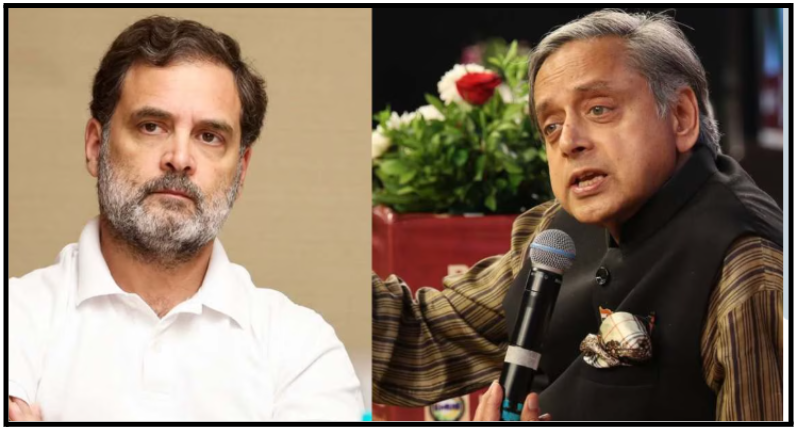
Tharoor’s Mysterious and Cryptic Response
Moments after Gandhi’s remarks went viral, a journalist on X (formerly Twitter) asked Tharoor about what he thought on the matter. His response was brief and multi-layered: “What can one say, alas.”
Tharoor’s tweet sparked a flurry of speculation. Is he disapproving of Rahul Gandhi quoting a foreign leader when chastising India’s economy? Is he concerned about the optics of quoting Trump, whom the Congress party has openly criticized for his divisive politics?
Considering Tharoor’s established deference as a diplomat and, his general quails about choice of language in going public with political commentary, the ambiguity of the statement was remarkable.
Political Responses Flood In
Tharoor’s response elicited different kinds of reactions across party lines. BJP leaders wasted little time in calling out Congress for its “anti-national” practice of attacking the Indian government based on comments made by foreign heads of state. Several BJP members characterized Gandhi’s statement as “shameful,” asserting he had defamed India in the eyes of the globe.
Meanwhile, Congress supporters maintained that Rahul’s quotation of Trump’s statement was simply a rhetorical device to highlight an overwhelming social reality of depressed economic activity. They reasoned that the Modi government frequently leveraged global validation to highlight success — therefore utilizing criticism from foreign officials should be equally tacitly acceptable.
Tharoor’s Tour de Force
Shashi Tharoor has navigated a touch-and-go relationship within the Congress. He has maintained loyalty to the party but he has not been afraid to voice disagreements with party leadership, especially when it comes to issues of narrative and party strategy. His response is subtle and distinctly similar to instances of nuance in dissent — he does not oppose Rahul Gandhi directly — nor does he endorse the strategy either.
Tharoor’s international experience as a former UN diplomat and personification of academia means he is likely to be apprehensive about mentioning contentious global figures, especially grudge-inducing figures, like Donald Trump – and it’s likely he believes that economic issues domestically should be answered with domestic statistics, rather than citing controversial information outside one’s country.
Conclusion
The situation reflects a larger headache for Congress in an issue of dis-conjoined communication strategy with itself. While Rahul Gandhi may have intended to provoke debate about domestic economic issues, referencing Donald Trump, who is subject to his own criticism based upon his leadership as president of the United States arguably took away from his appeal. Tharoor’s reaction indicates that he is uncomfortable with this method of gaining attention that resembles Trumpism and perhaps the party may perhaps need to use slightly more tact and solidarity going forward.
With India entering another significant election cycle, the manner in which the Congress party articulates its rhetoric—and with whom it aligns this rhetoric—could define its reputation and public image decisively and undoubtedly if there is a five-word equivocation in politics.